526
See the detailed hotel description on the web-site
SANTOR I N I - THE MOST STUNN I NG SUNSET OF THE PLANET !
GEOGRAPHY
Santorini is a small group of five volcanic islands of Thira, Therasia, Nea
Kameni, Palea Kameni and Aspronisi. This Cycladic group is located in
the Southern Aegean.
The area of Santorini, the southernmost island of Cyclades, is of 76 sq.
km and its coastline is of 70 km.
Santorini sits about 120 km to the north of Crete island and 200 km to
the south of Athens.
Its landscape is a mixture of volcanic cliffs and fertile valleys.
CLIMATE
The Mediterranean climate of the island feature hot dry summers and
mild rainy winters. In summer time the average temperature is about 28
Celsius degrees, and in winter it can be as cold as 13 Celsius degrees.
The rainy season lasts during autumn and winter periods.
TRANSPORT
You can get to the place either by air or by sea. The island has its own
national airport. It stays 6 km from the capital, not far from Kamari vil-
lage. The flight from Athens takes about 30-40 min.
The sea ships and ferry boats provide the necessary communication of
Santorini with the mainland and other islands of Cyclades and Dodeca-
nese. The trip from Piraeus port lasts about 4.5 hours.
MYTHOLOGY AND HISTORY
The story tells that long time ago Triton, a mythological Greek god, son
of Poseidon and Amphitrite, gave this piece of earth to the Argonauts as
a gift. Later on this piece has turned into an island. Some scientists also
believe that once Santorini was part of Plato’s mysterious Atlantis. It is
up to you to accept this point of view or not.
Once Argonauts were so impressed by the view of the island that they
called it Kallisti, which means “the most beautiful one”. Long before
the first eruption of the local volcano the island was known as Strongile
meaning “the circular one”. The name Santorini came into being in the
13th century when the island was under the Latin empire. It is a deriva-
tion from the name of the island’s saint “Santa Irina”. The name of Thira,
which is popular among locals, was given after the ancient Spartan hero.
The first evidences of human activity on the island can be traced back as
far as 3000 B.C. The influence of the Minoan Crete on the local culture
was proved by the finds in Akrotiri. Santorinian history in many cases
was determined by the local volcano. Its eruption in 1450 B.C. not only
changed the island’s landscape, but also, as some people believe,
caused the fall of the Minoan civilization. In 11th BC the Dorians led
by Fir landed to the shores of Santorini. During the Peloponnesian war
Santorini took the part of Sparta. Later on the Athenians took the
island. In 1207 Santorini is captured by the Venetians and in 1570 by the
Turks. With the end of the War of independence of 1821 Santorini joined
Greece. After the new volcano eruption in 1956 the landscape of the
place has changed again.
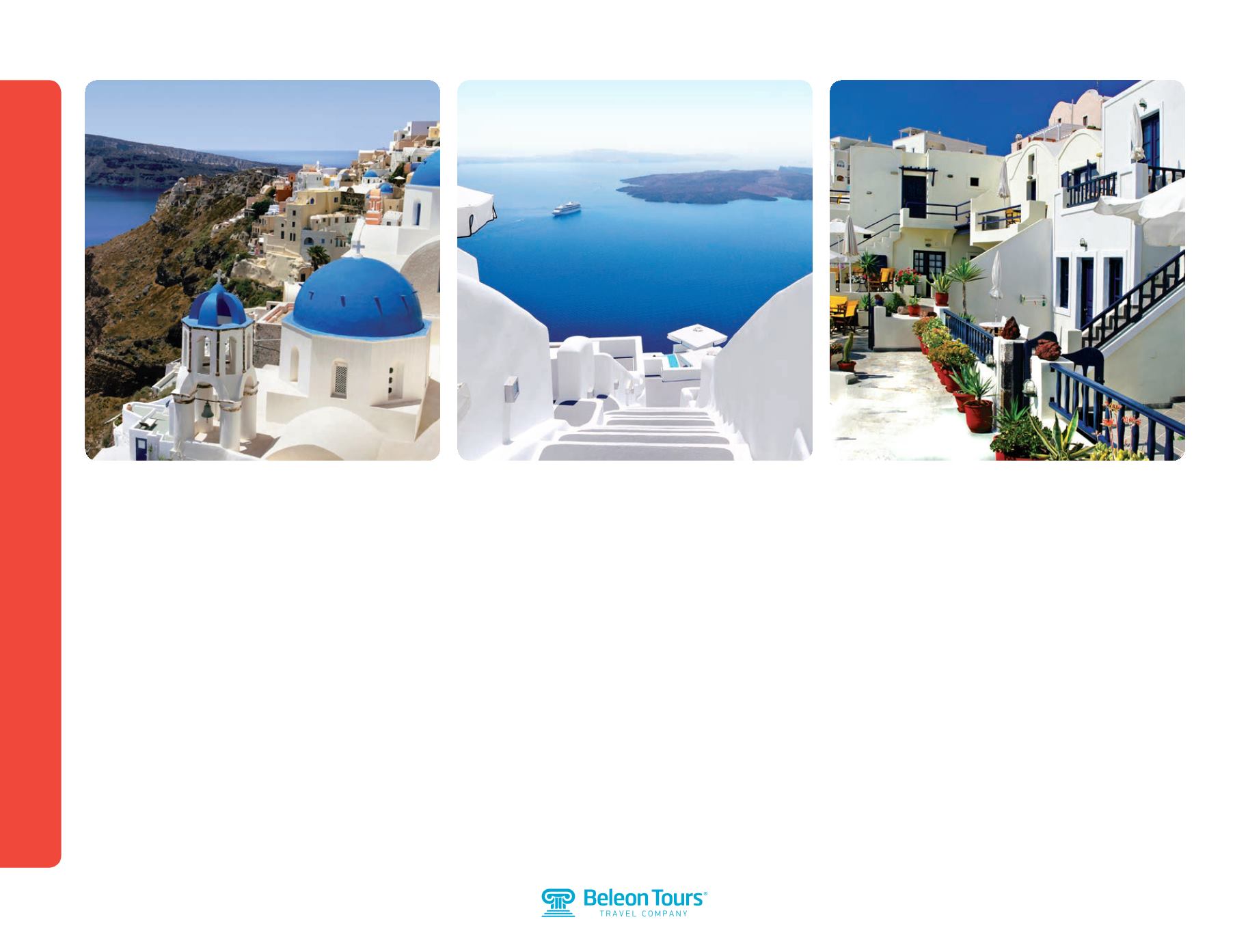
Words like “magical”, “fairytale”, “charming”
are not enough to express the island’s beauty
and uniqueness. This fairytale begins as soon as
you approach to it. Colourful rocks in different
colours, perfectness and harmony create a
dazzling picture. You willingly fall under its
spell. Summer time on Santorini is known for its
cosmopolitical atmosphere: people come here
from all over the world.
Always crowded countless bars of Thira,
Perissa, Kamari and other villages are famous
for their elegance and taste. Come and enjoy
this rare opportunity of watching a breathtaking
landscape of caldera and listening to the
classical music at the same time.
S A N T O R I N I - D E S C R I P T I O N


